
Oddschecker owns odds comparison, but every product hands the hardest job, the actual bet decision, back to the user. This is how we found that gap, proved the demand, and built the mobile flow that owns the decision.
The strategic bet
Oddschecker already exists, performs well, and dominates sports odds comparison. The first question wasn’t “how do I design a betting app,” it was “should this product exist at all?” Cloning a strong incumbent with a slightly cleaner UI is a fast way to waste a year of engineering. A new product is only worth building if research turns up a job the incumbent structurally can’t do.
Every product in this space is excellent at one slice of the journey and leaves the final decision to the user. Oddschecker is an aggregator funded by affiliate payouts from the bookmakers it lists. Because of that business model its neutrality is structural. It can’t take an editorial position or tell a user what to back. That limitation is our opening.
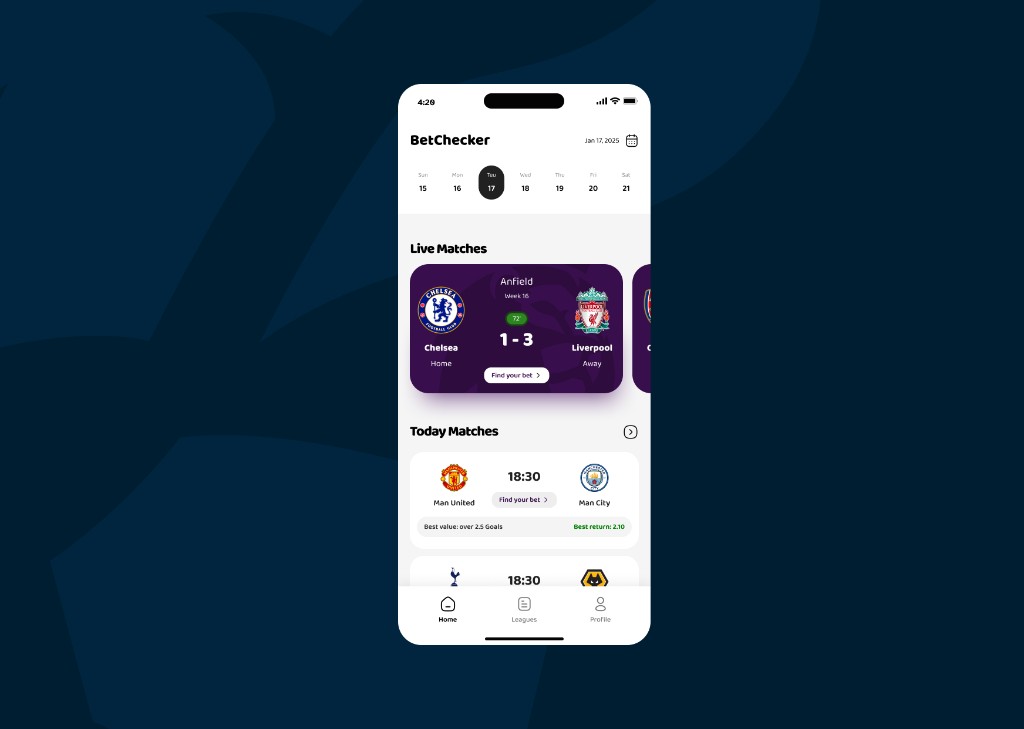
BetChecker. The home opens on the day's matches, each card surfacing the recommended bet and the best return instead of a wall of raw odds.
Why sports, and why mobile
Two scoping calls defined the product before any design started.
Analyzable sports, not casino games. A decision engine only earns its place where outcomes can be analyzed. There’s no strategic angle on a roulette wheel. A casino result is pure chance, which makes a decision tool there a contradiction. A football match involves form, injuries, tactical matchups, and history, so we focused entirely on analyzable sports.
Mobile only. The active sports bettor is time-pressured, frequent, and working on a phone, deciding pre-match or in-play with little time. It isn’t a leisurely desktop browse. It’s a high-stakes decision just before kickoff. The product had to live where the decision happens.
The competitive map
I ran a teardown of the major platforms, mapping the job each one owns, where it enters the journey, and what it hands back unfinished.
| Competitor | Core value | Journey entry | What it leaves unfinished |
|---|---|---|---|
| Oddschecker | Price optimization | Late, post-decision | No guidance on what or whether to bet |
| Covers | Deep statistical analysis | Early, research | Buries casual users in dense, unsorted data |
| Flashscore | Real-time updates | Mid to late, in-play | Reports the live state without translating it into value |
| Transfermarkt | Player data and valuation | Early, exploration | A historical database disconnected from the bet |
The pattern was clear. Every platform owns a station along the pipeline, and the decision itself stays unowned.
Validating the demand
A competitive gap proves a lack of supply, not the presence of demand. To check people actually wanted the gap closed, we looked at how they already behave.
Most bettors say they play to make money, but the behavior was the real proof. People were already building decision engines by hand. Open tabs everywhere, odds copied across platforms, validation hunted down in tipster forums, free prediction games used for confirmation. We didn’t need to ask whether people wanted help deciding. They were already doing the work themselves with badly integrated tools.
From friction to interface
Spreading one decision across several platforms creates predictable friction. We isolated four tensions to answer inside a single mobile flow.
Validation. “I found the best odds, but I still don’t know if I should place this bet.”
Integration. “I have five tabs open and I’m tracking price moves by hand.”
Translation. “One book offers a slightly higher price, but I can’t tell if it’s worth opening a new account for on my $20 stake.”
Trust. “I found the best price on a platform I’ve never heard of, and now I’m hesitant to enter my card.”
The product
We scoped the first release to two screens: the home feed and the match page. Choosing what not to build was deliberate, a way to test the core value before secondary features like history or personalization could get in the way.
The home feed. The app opens on the day’s matches, live and upcoming, not a wall of odds. Each card surfaces the single recommended bet and the best return across books, so the value reads at a glance, while the full reasoned call opens on the match page. It stays calm in an industry that leans on flashing banners to drive volume.
The match page. Tapping a match lays the whole decision on one vertical scroll, each block answering a specific friction. The call, for validation: an editorial point of view on the match, marked with a conviction level and backed by the few high-impact stats that matter, the guidance neutral aggregators avoid. The ranked bets, for integration and translation: every bookmaker for that bet in one live list, sorted so the best return is obvious and refreshable in place, so the comparison a user used to assemble across five tabs lives in one view, and the recommended bet and stake carry over automatically at the tap-through. Trust in place, for the trust drop-off: the top pick’s verification, licensing, payout speed, and deposit-limit tools sit right at the hand-off, settling the safety question at the exact moment of leaving for the bookmaker.
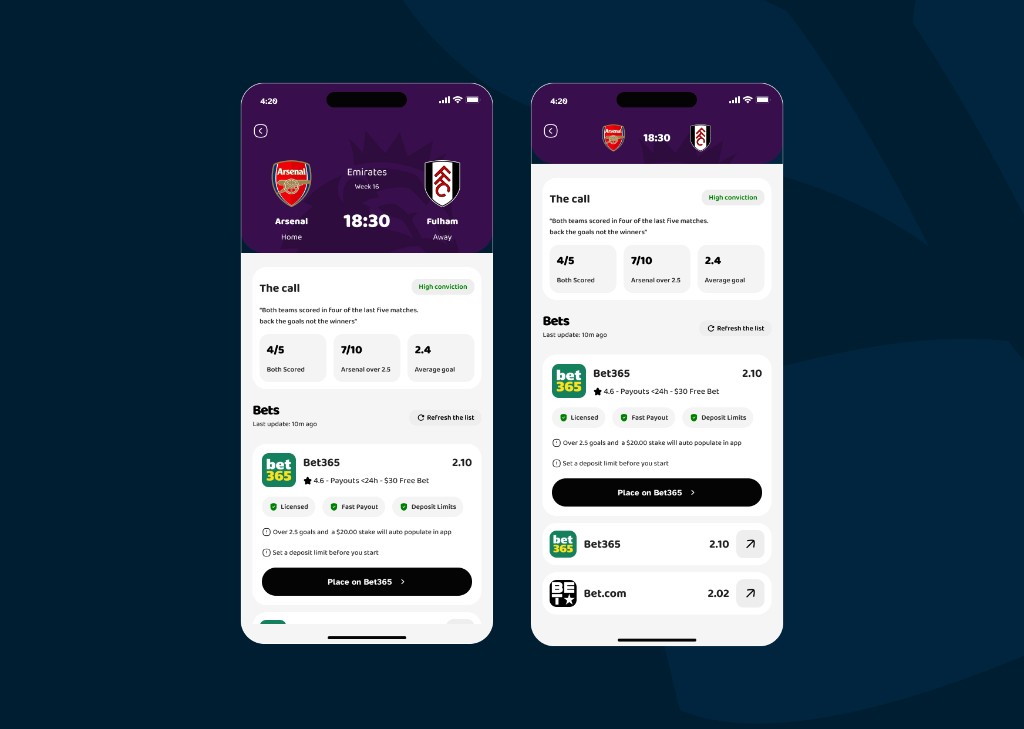
The match page on one scroll. The reasoned call with its conviction and stats, then every bookmaker ranked by return, then the top pick's trust profile at the hand-off.
What we learned
We shipped the core flows and tested them in qualitative sessions with active bettors.
The behavior confirmed the core assumption. People engaged with the call before they looked at the odds. Putting every bookmaker in one ranked list ended the tab-juggling they used to do by hand, and showing the top pick’s trust profile at the hand-off eased the hesitation before sending someone to a bookmaker they didn’t know.
The open challenge is retention. The current release works as a transactional tool but meets returning users as strangers. The next phase is a memory engine that remembers past choices, learns preferences, and tracks how the calls actually perform. That loop decides whether owning the decision becomes owning the daily habit.